History of the Lord Mayor’s Show The Elizabethan Lord Mayor’s Show
The Lord Mayor’s Show came to true prominence in the 1610s and 1620s, but the groundwork for those splendid entertainments was laid in the late Elizabethan period.
Only three printed pageant books survive from pre-1600, George Peele’s The Device of the Pageant (1585) and Descensus Astraeae (1591), and Thomas Nelson’s The deuice of the pageant from 1590. These books, although lacking in the elaborate detail one finds in the Jacobean and Caroline works, are our main source of evidence for the nature of the pageantry in those early days.
George Peele, known mostly now as the author of The Battle of Alcazar followed the lead of his father James, who had produced speeches for Christopher Draper’s mayoral inauguration in 1566. The speeches for 1568 (and quite probably 1561 too) were written by Richard Mulcaster, the first headmaster of the Merchant Taylors’ School, who is likely also to have composed speeches in English and Latin for Elizabeth I’s coronation entry into the City a decade previously, as well as acting in the same capacity for King James’s entry in 1604.
The Elizabethan Show followed the broad format of later Shows, with pageant devices accompanied by speeches declaiming the civic virtues expected of the new incumbent. In 1590 costumed actors delivered speeches either in the persona of some aspect of good civic governance such as ‘Wisedome’, ‘Plentie’ and ‘Loialtie and Concord’, or whilst sat on heraldic beasts like the unicorn. As this was a Fishmongers’ Company Show, naturally, the Company’s greatest hero William Walworth took centre stage. Accompanied by some of the other main protagonists of the 1381 Peasants’ Revolt, King Richard II and Jack Straw, Walworth reminded the watching crowds of his momentous deed: ‘I slew Jacke Straw, who sought my kings disgrace/ and for my act reapt honors of great prize’. [BL ms image of Walworth killing Tyler or Holborn viaduct statue of Walworth?] The speech actually makes two significant errors: Walworth killed Wat Tyler, not Jack Straw, and the dagger in the City’s arms refers to St Paul rather than the Fishmonger Lord Mayor, but it is unlikely that many would have noticed on the day.
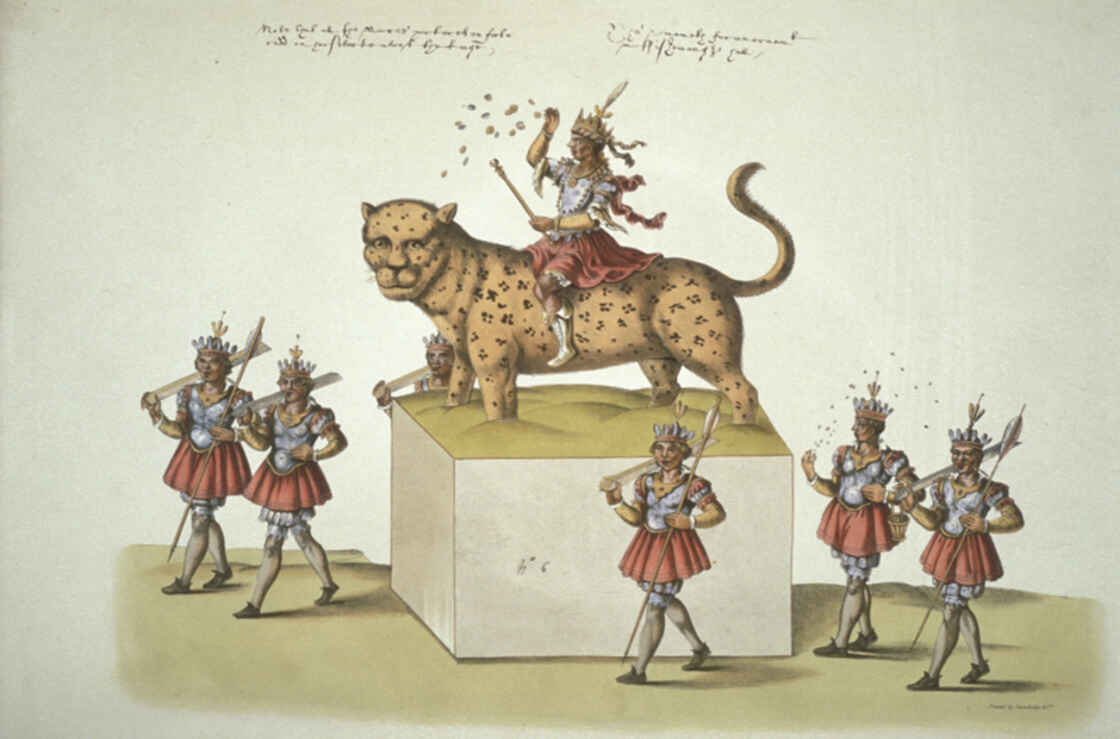
George Peele’s Show for Wolstan Dixie in 1585 was also composed of a sequence of speeches focused around one pageant only, with little sign of the more complex narratives structures one finds in the later Shows. A character dressed as a Moor and sat on a ‘luzarne’ (lynx) headed up the procession; he was followed by a ‘London’ pageant peopled with child actors (quite probably from the Merchant Taylors’ School) depicting honourable qualities like ‘Magnaminity’ as well as the Thames and the stock characters of ‘The Souldier’ and ‘The Sayler’. Four nymphs brought the proceedings to a close with an encomium emphasising virtue’s worthiness and the desired state of peace and quietness for the City.
A few years later Peele was back in the frame. Again we find only one pageant device on display, but the book did introduce the innovation of a thematic title, Descensus Astraeae, a trend which was picked up again in the early seventeenth century. The introductory speech also struck the historical note that was to become the norm. Like the 1585 Show with its nymphs, the 1591 production had a pastoral air with the figure of Astrea and her ‘sheephook’ surmounting the pageant. Unlike in the later Shows composed by writers such as Middleton, Munday and Dekker, however, direct reference to the Lord Mayor himself was confined to the speech delivered as he travelled by water to Westminster to make his oath, where he was exhorted to ‘Labour … as other Maiors of yore/ To beautifie the citie with desertes’. The post-Elizabethan Shows were to have a stronger take on individual Lord Mayors and their Companies and a deeper involvement in contemporary politics.